SolidWorks — Origins, Founders, and Key Designers

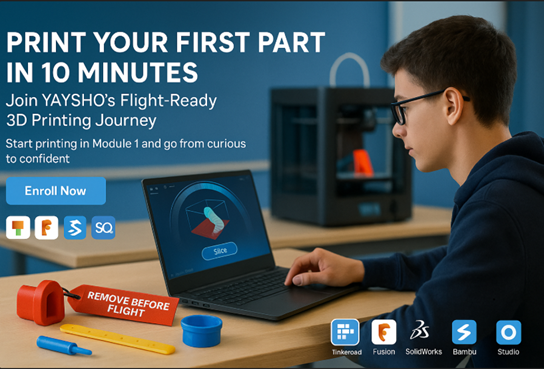
YOYSHO’s instructor-led virtual 3D Print Design Course delivers hands-on STEM learning through structured video instruction and guided exercises. Students are led step by step through digital design, slicing, and fabrication workflows, transforming ideas into real, functional objects using industry-grade tools and best practices. By the end of the course, students will have designed, printed, and assembled either a quadcopter drone or a fixed-wing aircraft, applying core principles of engineering, aerodynamics, and digital manufacturing in a real-world build.


Effective CAD design focuses on creating models that are clear, flexible, and practical to manufacture. Engineers follow several core principles to ensure their designs remain stable and easy to modify.
First, designers maintain design intent, meaning the model updates logically when dimensions change. Important features should be linked to parameters and reference geometry so the design adapts correctly during revisions.
Second, CAD models should use parametric modeling, where dimensions and constraints control the geometry. This allows designers to quickly adjust measurements and generate multiple versions of a part.
Third, sketches should remain simple and fully constrained. Simple sketches reduce errors and improve performance, while constraints ensure shapes remain stable and predictable.
Another key principle is maintaining a logical feature order. Structural features such as base shapes should be created first, while finishing details like fillets or chamfers should be added later.
Designers also rely on reference geometry, such as origin planes and axes, to ensure parts align properly and assemblies remain organized.
Finally, CAD models must follow design for manufacturing (DFM) principles. Engineers must consider how a part will actually be produced and ensure it can be manufactured efficiently and reliably.
By following these principles, engineers create CAD models that are accurate, adaptable, and ready for real-world production.